Motherboard
The main circuit board that every other part of a computer plugs into.
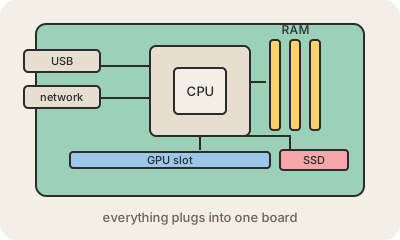
The motherboard is the large flat board inside a computer that connects everything else. The CPU sits in a socket on it, the RAM sticks clip into slots next to it, the SSD screws into its own slot, the graphics card plugs into a long connector, and the USB, audio and network ports on the back of a desktop are part of it. Thin copper lines printed on the board, called traces, carry the signals between all of them.
Besides wiring, the board carries a few chips of its own: a chipset that manages traffic between the CPU and the slower parts, the circuits that turn the power supply's current into the precise voltages the CPU needs, and a small piece of firmware (BIOS or UEFI) that wakes the hardware up and starts the operating system when you press the power button.
The motherboard decides what a computer can become. Its socket fixes which CPUs fit, its slots fix how much RAM and how many drives you can add, and its ports fix what you can plug in. In a laptop or a phone the same job is done by a smaller board where most parts are soldered directly on, which saves space but means you usually cannot upgrade them later.
Keep in mind
- Connects CPU, RAM, storage, graphics card and ports.
- Its socket and slots decide which parts are compatible.
- Holds the firmware (BIOS/UEFI) that starts the computer.
- In laptops and phones, most parts are soldered on and cannot be swapped.