CPU
The chip that runs your programs, one instruction after another, very fast.
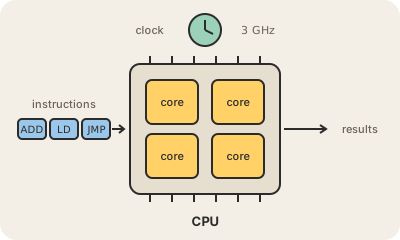
The CPU (Central Processing Unit) is the chip that executes programs. Everything a computer does, from opening a file to running a browser, is a stream of tiny instructions (add these two numbers, copy this to memory, jump to that line), and the CPU runs through them billions of times per second. It is the general-purpose brain: not specialized in anything, able to do everything.
A modern CPU has several cores, each one an independent processor, so it can run several programs (or several parts of one) at once; a laptop has around 8, a server 64 or more. Its speed is quoted in gigahertz (clock ticks per second), but the design of each core matters as much as the clock. Intel and AMD make most PC and server CPUs; Apple designs its own (the M series) on the ARM architecture, as do phone makers.
The CPU is good at varied, branching work with lots of decisions, which is most software. It is bad at doing the same simple calculation on millions of numbers at once, which is why graphics and AI moved to the GPU. Even then the CPU is still there, running the operating system and feeding the GPU its work.
When a computer feels slow today, the CPU is rarely the reason; more often it is waiting on RAM, the SSD or the network. But the CPU still decides how fast a single task finishes, and its power use decides how long a laptop battery lasts.
Keep in mind
- Runs all general-purpose software, instruction by instruction.
- Cores work in parallel; clock speed (GHz) is how fast each core ticks.
- Two instruction families dominate: x86 (Intel, AMD) and ARM (Apple, phones, more and more servers).
- Great at varied logic, weak at massive repeated math; that is the GPU's job.