Firmware
Software built into a device to run its hardware, from routers to washing machines.
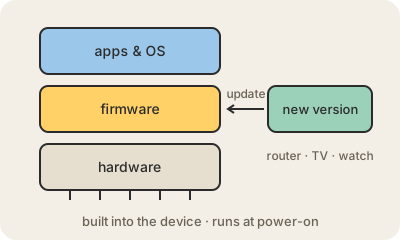
Firmware is the software that lives inside a device and makes its hardware work. It is stored on a memory chip in the device itself, not on a disk you can browse, and it starts running the moment the device gets power. Your router, your TV, your printer, a smartwatch, a car's dashboard and even a computer's keyboard and SSD each have their own firmware.
It sits between the hardware and everything else. In a simple gadget, like a thermostat or a microwave, the firmware is the whole program: it reads the buttons, drives the display and switches the heater on and off. In a computer or a phone, the firmware does the low-level work (waking up the chips, talking to the disk, managing the battery) and then hands over to the operating system. The BIOS and UEFI of a PC are firmware.
The name says where it sits: firmer than software you install, but not fixed forever like the hardware. Manufacturers release firmware updates to fix bugs, add features or close security holes, which is why a router or a phone sometimes asks to update and restart. Old devices that no longer get updates are a real risk, because their known vulnerabilities never get fixed. And an update should never be interrupted: if the power goes out halfway, the device can be left unable to start.
Keep in mind
- Stored on a chip inside the device and runs as soon as it powers on.
- Almost every electronic device has it, from routers to keyboards.
- Updates fix bugs and security holes; devices that stop getting them stay exposed.
- Never cut the power in the middle of a firmware update.