Chip
A sliver of silicon carrying billions of tiny switches that compute and remember.
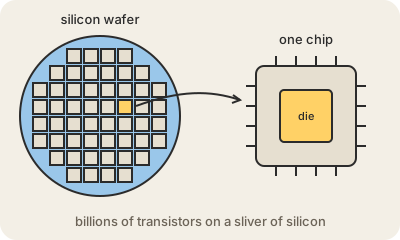
A chip (or integrated circuit) is a small square of silicon, often smaller than a fingernail, with an entire electronic circuit built into its surface: billions of transistors, the tiny switches that do all digital work, plus the microscopic wiring between them. The CPU and GPU are chips, so is the RAM, the flash memory in an SSD, and the controllers inside a microwave or a car.
Silicon is a semiconductor: a material that can be made to conduct electricity or block it, depending on how it is treated and on the voltage applied. That on/off control is exactly what a switch needs. Chips are made on round, polished wafers of pure silicon. In a factory called a fab, the circuit is projected onto the wafer with light, layer after layer, with features measured in nanometers. The wafer is then cut into hundreds of individual chips, each one tested and sealed in a plastic or ceramic package with metal contacts.
Two kinds of companies are involved, and the news often mixes them up. Some design chips (NVIDIA, Apple, AMD), and some manufacture them (TSMC, Samsung, Intel, which also designs its own). Building a leading-edge fab costs many billions of dollars and needs machines only a few suppliers can make, which is why chips have become a matter of economics and geopolitics, not just engineering.
Keep in mind
- A whole circuit of transistors and wiring built into one piece of silicon.
- Silicon is a semiconductor: it can be made to conduct or to block current.
- Made by the hundreds on a wafer, then cut, tested and packaged.
- Designing chips and manufacturing them are often done by different companies.
Go deeper
- Integrated circuit on Wikipedia
- Semiconductor device fabrication on Wikipedia
- Semiconductor on Wikipedia