Transistor
An electrically controlled switch, the basic building block of every chip.
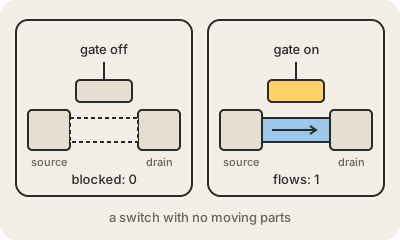
A transistor is a switch with no moving parts. It has three connections: current wants to flow between two of them (the source and the drain), and a small voltage on the third (the gate) decides whether it can. Gate on, current flows; gate off, it stops. On means 1, off means 0, and that is where the ones and zeros of computing physically live.
One switch does not do much. But wire a few together and you get logic gates, little circuits that answer questions like "are both inputs on?" (AND) or "is at least one on?" (OR). Combine gates and you can add numbers, compare them, and store a bit of memory. Stack that up by the billion and you have a CPU. The kind used in almost every modern chip is the MOSFET, built directly into silicon.
The first transistor was built at Bell Labs in 1947, a fist-sized device that replaced fragile vacuum tubes. Since then they have shrunk so much that a modern phone chip holds tens of billions of them, so small that more than a thousand would fit side by side across a human hair. Smaller transistors switch faster, use less energy and fit more per chip, which is the story Moore's law describes.
Keep in mind
- A switch controlled by voltage: gate on lets current through, gate off blocks it.
- On and off are the 1s and 0s of digital computing.
- Combined into logic gates, they add, compare and remember.
- Invented in 1947; modern chips hold billions of them.