AMD
The chip designer that competes with Intel in CPUs and with NVIDIA in GPUs.
AMD (Advanced Micro Devices) designs both main kinds of processors. Its CPUs are sold as Ryzen for PCs and EPYC for servers; its GPUs as Radeon for gaming and Instinct for AI data centers. It also designs the custom chips inside the PlayStation and Xbox consoles. For most of its history it was the smaller alternative to Intel in x86 processors, the instruction set both companies have the rights to make.
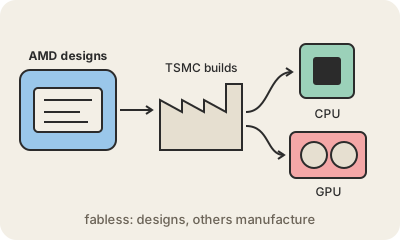
AMD is fabless: it designs chips but owns no factories. It sold its manufacturing arm in 2009 (it became GlobalFoundries), and today its most advanced chips are made by TSMC. That turned out to be a strength: when TSMC's manufacturing pulled ahead of Intel's, AMD's processors benefited directly, and the company went from near-bankruptcy in the mid-2010s to a major player in servers and PCs.
In AI, AMD is the main challenger to NVIDIA. Its Instinct GPUs compete for the same data center budgets, and its software stack, ROCm, is its answer to NVIDIA's CUDA. Closing that software gap matters as much as the chips themselves, because most AI code was written with NVIDIA in mind.
Keep in mind
- Designs CPUs (Ryzen, EPYC) and GPUs (Radeon, Instinct), plus console chips.
- Fabless: TSMC manufactures its most advanced chips.
- Competes with Intel in x86 processors and with NVIDIA in AI hardware.
- Its ROCm software is its alternative to NVIDIA's CUDA.