Clock speed
How many times per second a processor ticks, measured in gigahertz (GHz).
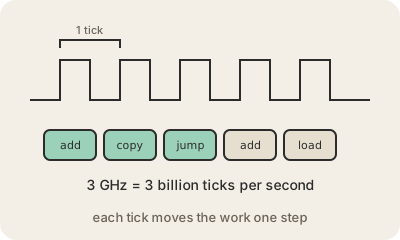
Inside every CPU there is a clock: a signal that pulses at a perfectly regular rhythm, and every part of the chip moves one step forward on each pulse. Clock speed is how fast that rhythm is. One hertz is one tick per second, so a CPU at 3 GHz (gigahertz) ticks three billion times every second. Typical desktop and laptop processors run at roughly 2 to 5 GHz.
A faster clock means more steps per second, but it is not the whole story. How much work a core gets done on each tick depends on its design, so a newer CPU at 3 GHz can easily beat an older one at 4 GHz. The number of cores matters too. Comparing GHz only makes sense between chips of the same family and generation.
Clock speeds climbed fast until the mid-2000s and then mostly stopped, at a few gigahertz. Each extra tick costs power, and power turns into heat; past a point the chip simply gets too hot to cool. The industry turned to more cores and smarter designs instead. Modern CPUs also change speed constantly: they slow down when idle to save battery, and briefly speed up (boost or turbo) when you need a burst, as long as they stay cool enough.
Keep in mind
- Clock speed is the number of ticks per second; 1 GHz is a billion ticks.
- Work per tick depends on the chip's design, so GHz alone does not rank CPUs.
- Speeds plateaued at a few GHz because heat grows with every extra tick.
- CPUs slow down when idle and boost briefly under load.