Claude
Anthropic's family of AI models, and the assistant app built on them.
Claude is the name of the large language models made by Anthropic, and of the assistant people use to talk to them. Like other chat assistants, it answers questions, writes and edits text, summarizes long documents, analyzes data, reads images and PDFs, and writes code. The first version came out in March 2023, and Anthropic releases new generations regularly, numbered like Claude 3 or Claude 4.
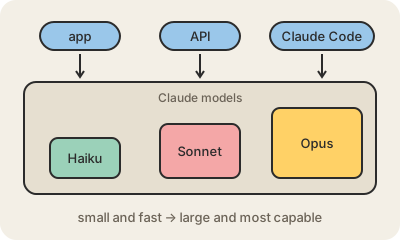
The models come in sizes with different trade-offs. Haiku is the small, fast and cheap one; Sonnet sits in the middle; Opus is the largest and most capable, and also the slowest and most expensive. There are several ways to reach them: the Claude app on the web, desktop and phone; an API that developers pay for per token; cloud platforms such as Amazon Bedrock and Google Cloud; and Claude Code, a tool that lets Claude work inside a software project, reading files, changing code and running commands.
What sets it apart is mostly how it is trained. Anthropic uses a method it calls Constitutional AI, where the model learns to follow a written set of principles, and it publishes research on safety and on understanding what happens inside the model. In practice Claude is widely used for writing, for analysis of long documents and for programming. Like any language model, it can be wrong while sounding sure, so it is a collaborator to check, not an oracle.
Keep in mind
- Made by Anthropic; the first version came out in March 2023.
- Three sizes: Haiku (fast), Sonnet (balanced), Opus (most capable).
- Available as an app, an API, through clouds and as Claude Code.
- Trained with Constitutional AI, guided by written principles.