LLM
A neural network trained on huge amounts of text to predict the next word.
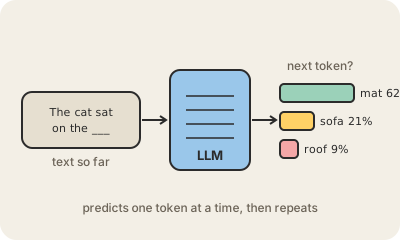
An LLM (Large Language Model) is a neural network trained on an enormous amount of text: books, websites, code, conversations. Its only job during training is to guess the next token in a sequence. Do that well enough across trillions of words and the model ends up absorbing grammar, facts, writing styles and a surprising amount of reasoning.
When you type a question into Claude or ChatGPT, the model does not look anything up. It reads your prompt, turns it into tokens, and produces the answer one token at a time, each time picking a likely continuation. The text you see is that stream of predictions, glued together.
'Large' refers to the number of weights (parameters), billions of them, and to the scale of data and GPU time used to train it. Bigger models usually generalize better, but they are also slower and more expensive to run, which is why companies offer several sizes of the same model.
LLMs matter because they turned language into an interface: you describe what you want in plain words and get a draft, a summary, a translation or working code. They also make things up with confidence (hallucination), so they work best with a person checking the output.
Keep in mind
- An LLM generates text one token at a time, predicting the most likely next one.
- Its knowledge is frozen in its weights at training time; it does not browse unless given tools.
- Claude, GPT, Gemini and Llama are all LLMs; they differ in size, data and training choices.
- Fluent is not the same as correct: check the facts.