Internet
A worldwide network of networks that lets any connected device reach any other.
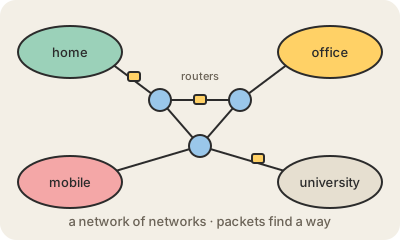
The Internet is a global network made of many smaller networks: those of homes, universities, companies, mobile carriers and internet providers, all connected to each other. No single company owns it or runs it. What holds it together is a set of shared rules, above all the Internet Protocol, which gives every connected device an IP address and lets data find its way from any point to any other.
Data does not travel as one continuous stream. It is cut into small packets, each labeled with where it comes from and where it is going. Routers along the way pass each packet one step closer to its destination, often across several countries and through undersea fiber-optic cables, and the receiving device puts the pieces back together. If one path fails, packets can take another, which makes the whole network very hard to break.
The Internet and the web are not the same thing. The web, the pages you open in a browser, is one service running on top of the Internet; email, video calls, online games, app updates and messaging are others. The Internet grew out of research networks in the United States in the late 1960s and 1970s, opened to the public in the 1990s, and today is coordinated by non-profit bodies that write the standards and hand out addresses and domain names.
Keep in mind
- A network of networks that nobody owns as a whole.
- Data travels in packets, passed router to router until it reaches an IP address.
- The web is one service on the Internet, alongside email, video calls and more.
- It works because everyone follows the same open standards.