Open standard
A public rulebook anyone can follow, so products from different makers work together.
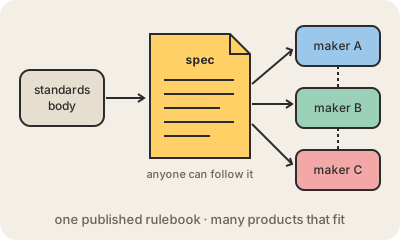
A standard is a written specification of how something must work: the shape of a plug, the format of a file, the messages two computers exchange. A standard is open when anyone can read it and build products that follow it without asking one company for permission. Typically it is written and maintained through a public process by a standards body, such as the W3C and WHATWG for the web, the IETF for internet protocols, the IEEE for Wi-Fi or ISO for many industrial formats, and it can be implemented royalty-free or under fair, published terms.
Familiar examples are everywhere. HTML is open, so any company can build a web browser and any person can publish a web page that all of them can show. USB is published by an industry group, which is why one cable fits laptops, phones and printers from different brands. PDF started as Adobe's format, but Adobe published it and in 2008 it became the ISO 32000 standard, so countless programs can create and read PDFs. TCP/IP, HTTP and Unicode are open standards too.
"Open" is a spectrum, not a yes or no. Some standards are free to read and free to implement; others require buying the document or paying patent licenses, and people disagree on whether those count. An open standard is also different from open source: the standard is the rulebook, while open source code is one particular implementation of it. And a de facto standard, a format everyone uses because one product became dominant, may still be controlled by a single company. The payoff of open standards is interoperability, competition and files that can still be read decades later.
Keep in mind
- Anyone can read it and build products that follow it.
- Usually maintained by a standards body through a public process.
- HTML, USB, PDF, TCP/IP and Unicode are well-known examples.
- Not the same as open source, and not the same as a de facto standard.