Open source
Software whose code anyone can read, use, change and share.
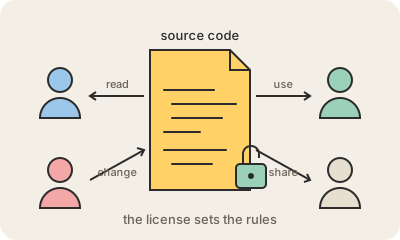
Open source software is software whose source code, the human-readable text that programmers write, is published for anyone to read, use, modify and redistribute. The rules are set by a license. Some (MIT, Apache) let you do almost anything, including selling it inside a closed product; others (GPL) require that if you distribute a modified version, you publish your changes too.
It is not a niche. Linux runs most servers and every Android phone, Git tracks most of the world's code, Python and JavaScript are open source, and so are Kubernetes, PostgreSQL and the browser engine behind Chrome. Most of it lives on GitHub, where anyone can report a bug or propose a fix in a pull request, and a small group of maintainers decides what gets in.
Companies fund it because shared infrastructure is cheaper than everyone building their own, and because an open project attracts users and talent. The business models are paid support, hosted versions (you can run PostgreSQL yourself for free, or pay AWS for Amazon RDS) and "open core", where the base is free and the extras are paid. In AI, "open-weight" models like Llama publish the trained model but not always the data or code that produced it.
Keep in mind
- "Free" here means the freedom to read and change the code; it is usually also free of charge, but that is a separate thing.
- The license decides what you may do: MIT and Apache are permissive, GPL requires sharing changes.
- It is maintained by volunteers and by paid engineers at large companies alike.
- Open source does not mean no owner: maintainers decide what gets merged.