Python
A popular programming language known for being easy to read and quick to write.
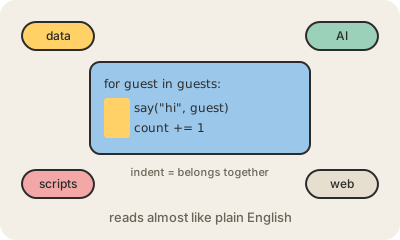
Python is a general-purpose programming language created by Guido van Rossum and first released in 1991. Its main idea is that code is read far more often than it is written, so it should look clean: a Python program uses plain words like for, in and if, and indentation (the spaces at the start of a line) to show which lines belong together.
It is used almost everywhere: data analysis, AI and machine learning, automating boring tasks with small scripts, web servers, scientific research and teaching. Much of its strength comes from its huge collection of free libraries, ready-made code you can install with one command, for things like reading spreadsheets, drawing charts or training neural networks.
Python is usually run by an interpreter, a program that reads your code and executes it line by line, instead of being compiled ahead of time. That makes it fast to try things out but slower than languages like C for heavy number crunching; in practice the heavy parts of popular Python libraries are written in faster languages underneath.
Keep in mind
- Created by Guido van Rossum; first released in 1991. The name comes from Monty Python, not the snake.
- Indentation is part of the language: it defines which lines go together.
- Dominant in data science and AI thanks to its libraries.
- Free and open source, run by the Python Software Foundation.