Artificial intelligence
Getting computers to do things that, until recently, only people could do.
Artificial intelligence (AI) is the broad name for building computer systems that do tasks we associate with human thinking: understanding language, recognizing faces, translating, playing chess, writing a summary, spotting a tumor in a scan. The term was coined in 1956, at a summer workshop at Dartmouth College, and the field has gone through several waves of excitement and disappointment since.
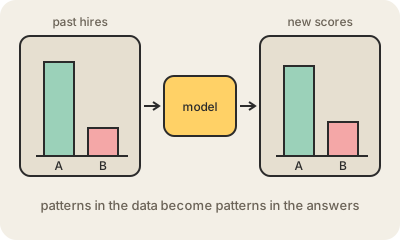
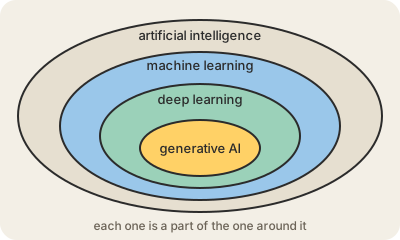
Early AI was mostly hand-written rules: if the patient has a fever and a rash, consider measles. That works for narrow problems but breaks in the messy real world. Almost all of today's AI is machine learning instead: rather than writing the rules, engineers show the system millions of examples and let it find the patterns itself. Deep learning, which uses large neural networks, is the branch behind the recent leaps.
When people say 'AI' today they usually mean one specific kind: large language models like Claude, ChatGPT or Gemini, which can hold a conversation and write. But AI also sorts your spam, suggests the next song, unlocks your phone with your face and routes your delivery. It is a set of statistical tools, very powerful in some tasks and surprisingly fragile in others, not a single thinking machine.
Keep in mind
- AI is the umbrella; machine learning and deep learning are branches inside it.
- Most modern AI learns patterns from data instead of following hand-written rules.
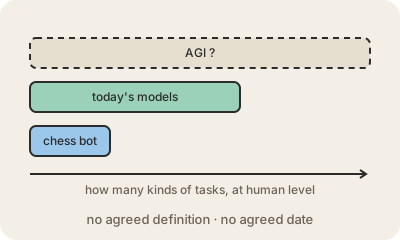
- Today's systems are good at specific tasks, not general-purpose minds.
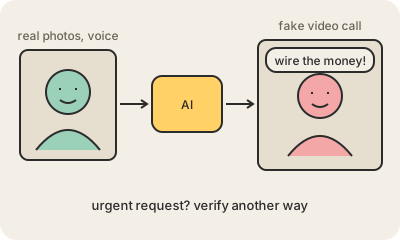
- It can be confidently wrong, so its output still needs checking.