Deep learning
Machine learning with many-layered neural networks, behind most recent AI leaps.
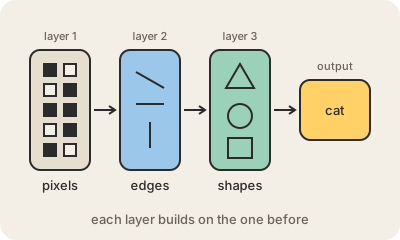
Deep learning is machine learning done with neural networks that have many layers stacked one after another. 'Deep' refers to that depth, not to any profound understanding. Each layer takes the output of the previous one and turns it into something a bit more abstract, so the network builds its own understanding of the data step by step.
In an image model, the first layers end up reacting to simple things like edges and color patches, the middle layers to textures and shapes like an eye or a wheel, and the last layers to whole concepts like 'cat' or 'bicycle'. Nobody programs those stages; they emerge during training. That is the big change from older machine learning, where people had to decide by hand which features of the data mattered.
The ideas are decades old, but deep learning only took off around 2012, when a network called AlexNet won an image recognition contest by a wide margin. Three things had come together: huge labeled datasets, GPUs fast enough to train large networks, and better training tricks. Since then it has powered speech recognition, translation, image generation and the large language models behind chatbots. The cost: it needs a lot of data and computing power, and it is hard to explain why a deep network gave a particular answer.
Keep in mind
- 'Deep' means many layers, each building on the one before.
- It learns which features matter on its own, without hand-picked rules.
- It took off around 2012 thanks to big datasets and GPUs.
- Powerful but data-hungry, expensive to train and hard to explain.