Computer vision
The part of AI that lets computers find and understand what is in images and video.
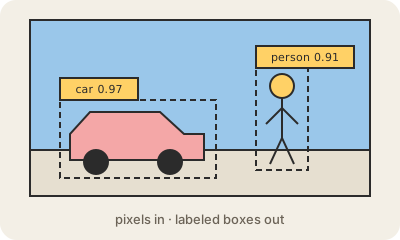
Computer vision is the field of AI that gets computers to make sense of images and video. To a computer a photo is just a grid of numbers, one per pixel; computer vision turns that grid into useful statements like 'there is a pedestrian 10 meters ahead', 'this X-ray shows a fracture' or 'this receipt says 4,250'.
It covers a family of tasks. Classification says what an image shows ('cat'). Object detection finds each thing and draws a box around it, with a confidence score. Segmentation outlines objects pixel by pixel. Others read text in images (OCR), recognize faces, estimate body poses or track objects across video frames. Modern systems learn all this with deep learning, trained on millions of labeled images; a turning point was 2012, when a deep network won the ImageNet image-recognition contest by a wide margin.
You use it constantly: unlocking a phone with your face, searching your photos for 'beach', depositing a check from the bank app, scanning a QR code, supermarket checkouts that recognize products. It also guides factory inspection, crop monitoring, medical imaging and cars that brake on their own. The weak spots are the usual ones for machine learning: it can fail on situations unlike its training images, and facial recognition in particular raises serious questions about errors, bias and surveillance.
Keep in mind
- Turns pixels into labels, boxes, outlines or extracted text.
- Main tasks: classification, detection, segmentation and OCR.
- Learned from huge sets of labeled images, using deep learning.
- Face recognition raises concerns about bias and surveillance.