AI agent
An LLM that can take actions, check the results and keep going until the job is done.
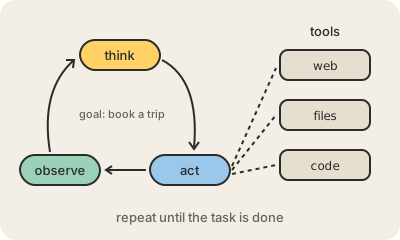
An AI agent is an LLM wrapped in a loop with tools. A plain chatbot answers once and stops. An agent receives a goal, decides what to do, uses a tool (search the web, read a file, run code, call an API, send an email), looks at the result, and decides the next step. It repeats until the goal is met or it gets stuck.
The tools are what make it an agent. Each tool is a function the developer exposes with a description; the model chooses when to call it and with what arguments. A coding agent like Claude Code, for example, can read your project, edit files, run the tests, see them fail and fix the code, without a person typing each command.
This is powerful and also where the risks live. An agent that can act can also act wrongly: delete the wrong file, buy the wrong ticket, loop forever. That is why serious agents ask for confirmation before irreversible steps, run in sandboxes with limited permissions, and keep a log of what they did.
Why it matters now: in 2023 the question was 'what can the model say?'; by 2026 it is 'what can the model do?'. Agents are how AI moves from answering questions to completing tasks, which is where most of the economic value, and most of the open problems, are.
Keep in mind
- Agent = model + tools + a loop: think, act, observe, repeat.
- Tools are ordinary functions or APIs the model can choose to call.
- Agents act on the world, so permissions, confirmations and logs matter.
- Open standards like MCP (Model Context Protocol) let agents connect to tools and data in a uniform way.