Open-weights models
AI models whose trained numbers anyone can download and run on their own machines.
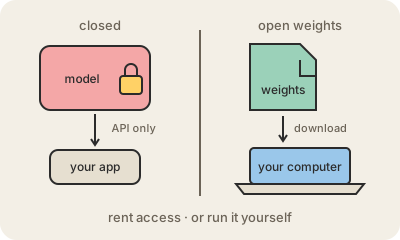
An open-weights model is an AI model whose weights, the billions of numbers learned in training, are published for anyone to download. With them you can run the model on your own computer or servers, inspect it and adapt it, instead of only renting access through someone else's API. Meta's Llama, Google's Gemma, Mistral's models and those from Chinese labs such as Alibaba (Qwen) and DeepSeek are well-known examples, and OpenAI released open-weights models too.
'Open weights' is not quite the same as 'open source'. Open-source software gives you the full recipe; most open-weights releases give you the finished dish but not the training data or all the code used to make it. Licenses also vary: some allow almost any use, others add conditions, for example for very large companies. In 2024 the Open Source Initiative published a definition of open-source AI that asks for much more than weights, and few popular models meet it.
Why people use them: privacy, because data never leaves your machines; control over cost and versions, since nobody can change or retire the model under you; and freedom to fine-tune. Tools like Ollama and sites like Hugging Face make downloading and running them fairly easy, as long as you have enough memory. The trade-offs: you run and secure it yourself, the best closed models are often still more capable, and once weights are released they cannot be recalled, which means safety restrictions can be removed by whoever downloads them.
Keep in mind
- The trained weights are published and can be downloaded.
- Runs on your own hardware, so data can stay private.
- Usually not fully open source: training data is rarely included.
- Licenses differ, and released weights cannot be taken back.
Go deeper
- Open-source artificial intelligence on Wikipedia
- The Open Source AI Definition (OSI)
- Models on Hugging Face