Domain name
The readable name of a website, like wikipedia.org, that stands in for a numeric address.
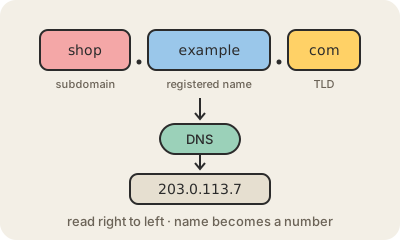
A domain name is the human-friendly name of a place on the internet, like wikipedia.org or bbc.co.uk. Computers find each other by IP address, a string of numbers that is hard to remember and can change. The domain name is the stable label people type, and DNS is the system that translates it into the current IP address.
Domain names are read from right to left. The last part is the top-level domain (TLD): generic ones like .com and .org, or country ones like .ar, .es and .mx. To its left is the name an organization registers, and anything further left is a subdomain it creates freely, like es.wikipedia.org or mail.example.com.
Nobody owns a domain forever: you rent it, usually by the year, through a registrar, a company accredited to sell names under each TLD. The whole naming system is coordinated by ICANN, and each TLD has a registry that keeps its official list. If a renewal is forgotten, the name can lapse and someone else can register it, which is why companies guard their domains closely.
Keep in mind
- A readable name that DNS translates into an IP address.
- Read right to left: top-level domain, registered name, subdomains.
- You rent a domain through a registrar, usually renewing yearly.
- ICANN coordinates the system; each TLD has its own registry.