Docker
The tool that made containers easy: package an app once, run it anywhere.
Docker is a set of tools for building and running containers, made by the company of the same name. Released in 2013, it took an old Linux idea and made it usable by any developer, which is why many people still say "a Docker" when they mean a container.
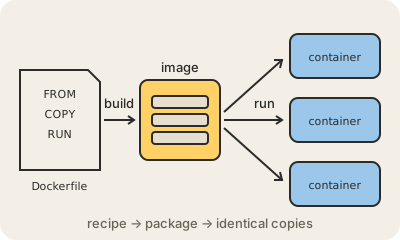
The workflow has three steps. You write a Dockerfile, a short text recipe: start from this base system, copy my code, install these libraries, run this command. docker build turns the recipe into an image, a sealed package with everything the app needs. docker run starts a container from that image, and you can start as many identical copies as you want.
Images are shared through a registry, a library of images; Docker Hub is the best-known public one, and clouds offer private ones like Amazon ECR. This is what makes Docker useful: the same image runs on a laptop, a test server and production, so "it works on my machine" stops being an excuse. The image format is now an open standard, so images built with Docker also run on Kubernetes and other tools that never touch Docker itself.
Keep in mind
- Dockerfile is the recipe, image is the package, container is the running copy.
- Registries such as Docker Hub store and share images.
- The image format is an open standard, so images run outside Docker too.
- Docker is the tool; the container is the general idea.