Operating system
The base software that runs a device and lets every app share its hardware.
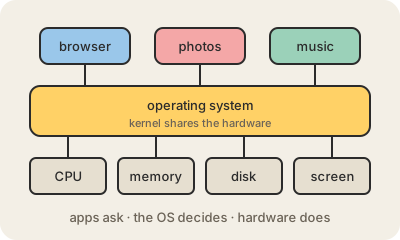
An operating system (OS) is the software that starts when you turn on a device and stays in charge until you turn it off. Windows, macOS, Linux, Android and iOS are operating systems. Its job is to manage the hardware, the CPU, the memory (RAM), the storage, the screen, the network, and to share it fairly among all the apps you run.
Without an OS, every app would need to know how to talk to your exact disk, keyboard and Wi-Fi chip, and two apps could overwrite each other's memory. The OS hides those details behind a common set of services: "save this file", "draw this window", "send this over the network". It also keeps apps apart from each other, so a crashing app does not take the whole machine down, and asks your permission before one uses the camera or your location.
The core of an operating system is called the kernel: the part that talks directly to the hardware and decides which program runs on the CPU at each moment. Around it come the things you actually see, like the desktop, the file browser, settings and built-in apps. That is why an app made for one OS usually does not run on another without changes.
Keep in mind
- Examples: Windows, macOS, Linux, Android, iOS.
- Shares the CPU, memory, storage and devices among all running apps.
- Its core, the kernel, talks directly to the hardware.
- Apps are written for a specific OS, which is why some only exist for one.