Moore's law
The observation that chips fit about twice as many transistors every two years.
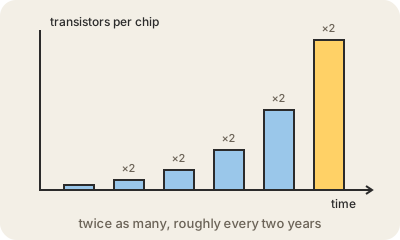
In 1965, Gordon Moore, who later co-founded Intel, noticed that the number of transistors that could be put on a chip was doubling at a steady pace. In 1975 he revised the pace to roughly every two years. That prediction, known as Moore's law, held up remarkably well for about half a century.
It is not a law of physics. It is an observation about engineering and economics, and for decades the industry treated it as a target, planning each new generation of factories to hit the next doubling. The results compound quickly: doubling every two years means roughly a thousand times more transistors every twenty years. That is why a phone today outperforms the supercomputers of the early 1990s, and why computers kept getting cheaper and more capable at the same time.
The pace has slowed. Transistors are now so small that each further step is harder, slower and far more expensive, and making them faster stopped being free around the mid-2000s because chips got too hot. The industry keeps progressing in other ways: more cores per chip, specialized chips like the GPU, stacking chips in 3D, and packaging several smaller chips together. So people argue about whether Moore's law is dead, but its effect, cheaper computing every year, still shapes the industry.
Keep in mind
- Transistors per chip doubled roughly every two years for decades.
- An observation and an industry target, not a law of nature.
- Compounding made computers vastly cheaper and more powerful.
- It has slowed; progress now also comes from specialization and packaging.