Smartphone
A pocket computer that also makes phone calls.
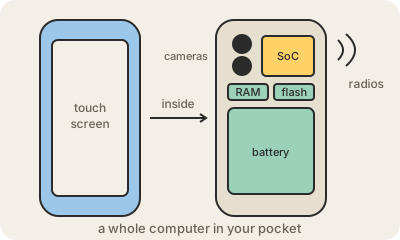
A smartphone is a full computer that fits in your hand. It has a processor, memory, storage and an operating system, just like a laptop, plus things a laptop rarely has: a cellular radio to connect to the mobile network anywhere, GPS, several cameras and a dozen sensors. Phone calls are now one of the least used things it does.
Inside, the heart is a system on a chip that holds the CPU, the GPU, an NPU for AI tasks and the modem. Around it sit the RAM and flash storage, a lithium-ion battery that takes up most of the space, a touchscreen, and radios for the cellular network, Wi-Fi, Bluetooth and NFC (for paying with your phone). Two operating systems dominate: Android, made by Google and used by many brands like Samsung and Xiaomi, and iOS, which only runs on Apple's iPhone.
The iPhone in 2007 set the shape almost every smartphone still has: a big touchscreen instead of a keyboard, and an app store to install new software. Today more than half the people on Earth own one, and for many it is their only computer and their only way onto the internet. That is why so much software is designed "mobile first", and why battery life, the camera and how long the maker sends updates are the things people compare most.
Keep in mind
- A full computer with a mobile network connection, GPS, cameras and sensors.
- Built around a system on a chip, with a lithium-ion battery taking most of the space.
- Android and iOS are the two dominant operating systems.
- For many people it is their only computer and only way online.