Smart home
A home whose lights, locks and appliances run from a phone or on their own.
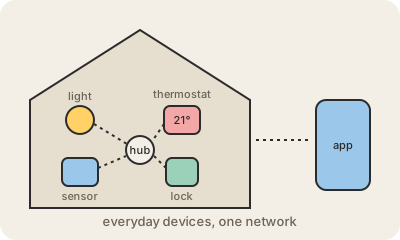
A smart home is a home with devices that connect to a network and can be controlled remotely or set to act on their own: lights you dim from your phone, a thermostat that lowers the heat when everyone leaves, a door lock that opens with a code, a camera that sends a clip when someone rings. It is the Internet of things applied to your house.
Each device has a small chip, a radio and often a sensor. They connect over Wi-Fi or over low-power networks designed for this, such as Zigbee, Z-Wave or Thread, sometimes through a hub. An app or a voice assistant lets you control them, and simple rules tie them together: "when the motion sensor sees nobody for 20 minutes, turn off the lights". The appeal is comfort, saving energy, and peace of mind when you are away.
For years the big problem was that brands did not talk to each other, so a bulb from one company might not work with a speaker from another. Matter, a standard backed by Apple, Google, Amazon, Samsung and others and launched in 2022, aims to fix that. Other concerns remain. Many devices depend on the maker's cloud and stop working if it shuts down, and every connected camera, lock or microphone is one more thing that has to be kept updated and secure.
Keep in mind
- Connected devices at home, controlled by app, voice or automatic rules.
- Talk over Wi-Fi or low-power networks like Zigbee, Z-Wave and Thread.
- Matter is the shared standard meant to make brands work together.
- Depends on the maker's cloud and on keeping devices updated and secure.