System on a chip
One chip that holds a computer's main parts: CPU, GPU, memory control and more.
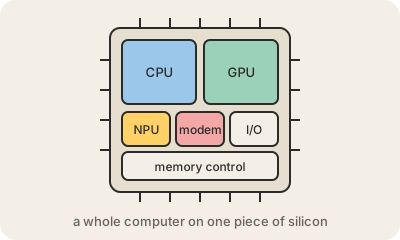
A system on a chip (often shortened to SoC) puts most of a computer's main parts on a single piece of silicon. Instead of a separate processor, graphics card and controller chips spread over a motherboard, one chip holds the CPU cores, a GPU, often an NPU for AI tasks, the controllers for memory, screen, camera and USB, and in phones the cellular modem. Every smartphone runs on one, and so do tablets, smartwatches, many laptops and the Raspberry Pi.
Packing everything together has big advantages. Signals travel millimeters instead of centimeters, so the parts talk to each other faster and use much less energy, which means longer battery life and less heat. The device can also be thinner and cheaper to build. Apple silicon Macs, most Android phones and many small devices are built around one, usually based on the Arm architecture.
The trade-off is flexibility. In a desktop PC you can swap the graphics card or add more RAM; in a system on a chip the parts are fixed when the chip is designed, and the memory is often soldered right next to it or inside the same package. Designing one is also very expensive, so only large companies design their own from scratch, while many others combine licensed building blocks.
Keep in mind
- Puts the CPU, the GPU and many controllers on one piece of silicon.
- Uses less power and space, which is why every smartphone has one.
- Its parts cannot be upgraded separately, unlike in a desktop PC.
- Most are based on the Arm architecture.