Quantum computer
A machine that uses quantum physics for a few specific problems. Not a faster PC.
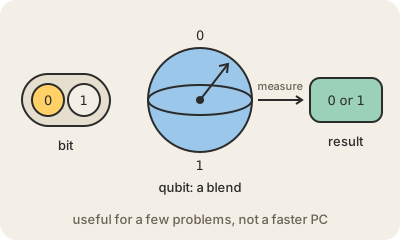
A quantum computer stores information in qubits instead of ordinary bits. A normal bit is either 0 or 1. A qubit can be in a superposition, a blend of both, and several qubits can be entangled, so their states are linked. A quantum algorithm arranges those states so that, when the qubits are finally measured, wrong answers tend to cancel each other out and the right one is likely to appear. It does not "try every answer at once", as is often said; it relies on a very particular kind of interference.
That trick only helps with certain problems. The best known are simulating molecules and materials, which are quantum systems themselves, and factoring very large numbers, which would break much of today's public-key cryptography. For everyday tasks like email, spreadsheets, games or running a website, a quantum computer offers no advantage and would do far worse than a laptop. It is a specialized tool, not a faster replacement for normal computers.
Today's machines are real but small and fragile. Qubits lose their state with the slightest heat, vibration or stray signal, so many designs are cooled to a fraction of a degree above absolute zero, and they still make frequent errors. Building enough reliable, error-corrected qubits to run useful algorithms at scale is the central unsolved problem, and nobody can honestly say when it will be solved. Security experts are not waiting: NIST has already published post-quantum cryptography standards, new algorithms designed to resist future quantum attacks.
Keep in mind
- Uses qubits, which can be in superposition and entangled with each other.
- Helps with specific problems like simulating molecules or factoring, not everyday tasks.
- Current machines are small, error-prone and need extreme isolation, often extreme cold.
- Post-quantum cryptography is already being adopted to protect today's data.