Shadow IT
Apps and services people use for work without the IT team knowing.
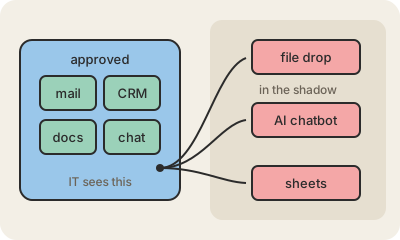
Shadow IT is any software, cloud service or device used for work outside the official, approved list. A sales team that tracks deals in a personal spreadsheet app, a designer who sends client files through a free transfer site, a manager who signs up for a project tool with a company credit card: none of it is malicious, and most of it starts because the official tool is slow or missing. The trouble is that the security team cannot protect what it does not know exists.
The risks are concrete. Company data ends up in accounts protected by a reused password and no 2FA. When someone leaves, their personal account with the client list goes with them. Nobody checks whether the service meets the company's legal duties for personal data. And nobody gets the alert when that service suffers a data breach. SaaS made this easy: anyone with an email address can sign up in a minute, no installation needed.
The newest version is shadow AI: employees pasting documents, code or customer data into public chatbots. In 2023 Samsung restricted staff use of generative AI tools after engineers pasted internal source code into ChatGPT. Banning everything rarely works; people route around it. Most companies instead discover what is in use (from network logs, expense reports, or tools called CASBs), offer approved alternatives that are actually good, and connect them to single sign-on so access ends when the job does.
Keep in mind
- It is usually well-meant, not malicious.
- IT cannot secure, back up or offboard what it cannot see.
- Shadow AI is the same problem with chatbots and sensitive data.
- Better approved tools beat blanket bans.