Air gap
Keeping a computer or network physically cut off from everything, internet included.
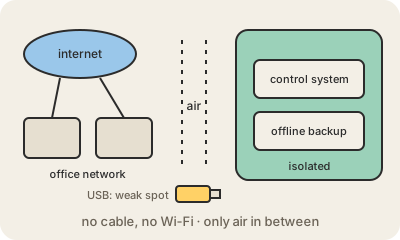
An air gap means there is literally nothing but air between a sensitive system and the outside world: no cable, no Wi-Fi, no Bluetooth, no connection to the internet or to the office network. If an attacker cannot reach a machine over a network, a whole category of remote attacks simply does not apply. Systems built this way are called air-gapped.
It is used where the stakes are high: military and intelligence networks that handle classified information, the control systems of power plants and factories, voting tabulation machines in some places, and the offline copy of a company's backups. A ransomware gang that takes over the whole office network still cannot encrypt a backup that sits disconnected in a safe. Cold wallets for cryptocurrency follow the same idea.
An air gap is strong but not magic. Data still has to move in and out somehow, often on USB drives, and that is the weak point. The Stuxnet worm, discovered in 2010, is thought to have reached isolated Iranian nuclear equipment that way, then quietly damaged the centrifuges. Insiders can also carry things across, and researchers have shown exotic leaks through sound, heat or blinking lights. The cost is convenience: every update and every file transfer becomes a manual, controlled procedure.
Keep in mind
- No network connection at all: physically separated from the outside.
- Used for classified networks, industrial control and offline backups.
- USB drives and people crossing the gap are the usual weak point.
- Stuxnet showed that an air gap reduces risk but does not erase it.