AI watermarking
Hidden marks placed in AI-generated content so software can recognize it later.
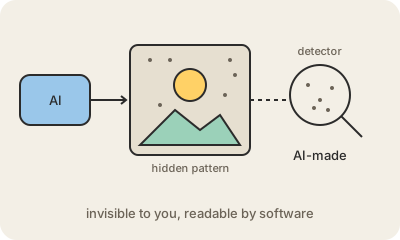
AI watermarking means hiding a signal inside content while an AI creates it: an image, a video, a voice, even text. People cannot see or hear it, but a matching detector can find it later and say "this came from that model". The goal is to tell synthetic content from real content at a time when deepfakes and text-to-image tools make them hard to tell apart.
For images and audio, the generator changes pixels or sound in tiny, patterned ways designed to survive cropping, compression or a screenshot. For text it is subtler: while choosing each next token, the model slightly favors some words over others following a secret key, and the detector checks whether a text leans that way more than chance would explain. Google DeepMind's SynthID works across images, audio, video and text, and Google released the text version as open source in 2024.
A related approach is provenance metadata, like the C2PA standard behind "Content Credentials": a signed label attached to the file that says who made it and with which tools. It is precise, but it lives beside the content rather than inside it, so a re-upload or a screenshot can strip it.
Watermarks have limits too. Each company's mark only works with its own detector, open-weights models can be run with no mark at all, and heavy edits or rewording can wash a mark out. So finding no watermark proves nothing. Even so, rules like the EU AI Act ask providers to mark AI-generated content in a machine-readable way, which is pushing watermarks into more products.
Keep in mind
- An invisible signal added at creation, readable by a matching detector.
- Text watermarks nudge word choices in a statistically detectable way.
- Metadata labels like C2PA are precise but easy to strip.
- Finding no watermark does not mean a person made it.
Go deeper
- SynthID (Google DeepMind)
- C2PA: Coalition for Content Provenance and Authenticity
- Digital watermarking on Wikipedia