AI regulation
The laws that set what AI systems may do, and who answers when they go wrong.
AI regulation is the set of laws and rules governments write for artificial intelligence: what is forbidden, what needs extra checks, what people must be told. It is not one law but a patchwork that is changing quickly, because AI now helps decide who gets a loan, a job interview or a medical test.
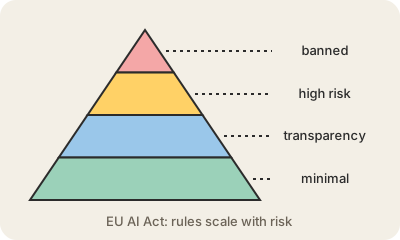
The most complete example is the European Union's AI Act, which entered into force in August 2024 and whose obligations kick in gradually over several years. It sorts uses by risk. A few are banned outright, such as social scoring by governments or systems that manipulate people by exploiting their vulnerabilities. High-risk uses, like screening CVs, grading exams or deciding on credit, must meet requirements on data quality, human oversight and documentation. Chatbots and deepfakes carry transparency duties: people must know they are talking to a machine or looking at AI-made content. Everyday uses like spam filters get no new obligations. Fines for the worst violations can reach 35 million euros or 7% of a company's worldwide annual turnover.
Elsewhere the picture is mixed. The United States has no single federal AI law and relies on existing rules plus a growing number of state laws; China has specific rules for generative AI and recommendation algorithms; Brazil, Canada and others have debated their own bills. Older laws also still apply to AI: privacy rules like GDPR, consumer protection, anti-discrimination. For a company, the practical question is less "is AI legal?" and more "what does this particular use require?"
Keep in mind
- The EU AI Act sorts AI uses by risk: banned, high, limited, minimal.
- High-risk uses (hiring, credit, exams) need human oversight and documentation.
- People must be told when they talk to a bot or see AI-made content.
- Privacy, consumer and anti-discrimination laws already apply to AI.
Go deeper
- AI Act (European Commission)
- Regulation of artificial intelligence on Wikipedia
- Artificial Intelligence Act on Wikipedia