Microcontroller
A tiny, cheap computer on one chip, built to control one specific thing.
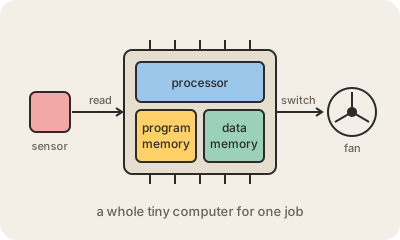
A microcontroller (MCU) is a complete small computer on a single chip: a modest processor, a little memory for the program and data, and pins that connect directly to the outside world. It does not run Windows or apps. It runs one program, stored in its firmware, over and over: read a button, check a sensor, turn on a motor, repeat.
They are everywhere, usually invisible. A microwave, a washing machine, a TV remote, a car (which can have dozens of them), a thermostat, a smart lightbulb, a computer keyboard: each has at least one. They cost from a few cents to a few dollars, use very little power (some run for years on a coin battery) and start instantly.
Compared with the processor in a laptop, or even a Raspberry Pi, a microcontroller is far less powerful: memory is measured in kilobytes, not gigabytes. That is the point. It is designed for simple, reliable, real-time control at the lowest cost and power. Hobbyists and students meet them through Arduino, an open-source board and programming environment that made microcontrollers easy to use, and through the ESP32, a cheap chip with Wi-Fi built in that powers many Internet of things gadgets.
Keep in mind
- Processor, memory and input/output pins on a single chip.
- Runs one program in a loop to control a device.
- Costs cents to a few dollars and uses very little power.
- Arduino and ESP32 boards are the usual way to start tinkering with them.