Cyber insurance
An insurance policy that pays for the costs of a cyberattack or data breach.
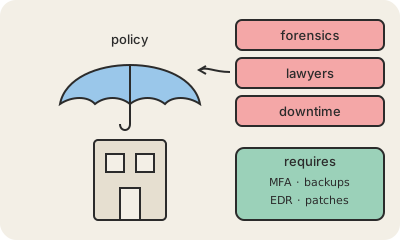
Cyber insurance covers the money a company loses when it gets hacked. A serious incident is expensive in many small ways: outside experts for forensics, lawyers, notifying every affected customer, credit monitoring for them, public relations, and the revenue lost while systems are down. A policy can pay for part of that, and many include a hotline that connects the company with an incident response firm within hours. Some policies have also covered ransom payments, which is one of the most debated parts of the market.
Insurers learned the hard way during the ransomware wave of the late 2010s and early 2020s, when claims grew fast. Since then getting a policy looks a lot like a security audit: questionnaires and scans asking whether you use MFA everywhere, keep offline backups, run EDR on your computers and patch quickly. Missing a basic control can mean a higher premium, a lower limit or no policy at all, so the insurance industry has become one of the forces pushing companies toward better security.
The fine print matters. Policies have deductibles, caps and exclusions, and the most famous fights were about "acts of war". After the 2017 NotPetya attack, which governments attributed to Russia, the food company Mondelez sued its insurer, Zurich, for refusing to pay on those grounds. Insurance does not replace security: it pays for some of the damage, but it does not bring back lost data or customer trust.
Keep in mind
- It pays for forensics, legal costs, notifications and downtime.
- Insurers now require controls like MFA, backups and EDR.
- Exclusions, such as acts of war, can decide whether it pays.
- It covers costs, not lost data or reputation.
Go deeper
- Cyber insurance on Wikipedia
- Cyber insurance guidance (UK National Cyber Security Centre)
- What is cyber insurance? (IBM)