Packet loss
When pieces of your data leave but never arrive.
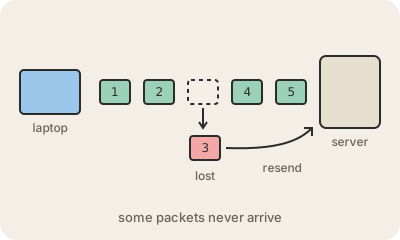
Everything you send over the internet is cut into small packets that travel separately. Packet loss is when some of them never reach the other end. It is measured as a percentage: if 2 out of every 100 packets vanish, you have 2% packet loss.
Packets get lost for ordinary reasons. A router with a full queue during a traffic jam simply throws the extra ones away. A weak Wi-Fi signal, interference, a damaged cable or an overloaded server can corrupt or drop them too. A little loss happens all the time and the internet is designed for it; the question is how much, and what kind of app is on the receiving end.
For downloads and web pages, TCP notices the gap and asks for the missing packet again, so nothing is lost but everything slows down. Real-time apps cannot wait for resends: in a video call or an online game a lost packet becomes a robotic voice, a frozen face or a character that jumps. Even a small percentage can be noticeable. Tools like ping and many speed tests report packet loss, and moving closer to the router or using a cable is often the quickest fix.
Keep in mind
- The share of packets that never arrive, given as a percentage.
- Causes: congestion, weak Wi-Fi, interference, bad cables, overloaded equipment.
- TCP resends lost packets, so downloads slow down instead of breaking.
- Calls and games suffer most, because late packets are useless to them.