Data analyst
The person who turns a business question into numbers, and the numbers into an answer.
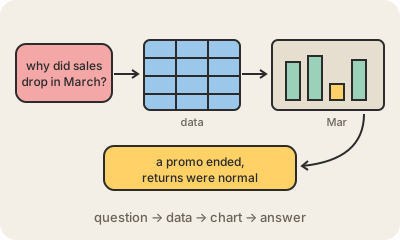
A data analyst takes a question someone in the business has, like "why did sales drop in March?" or "which stores sell the most on weekends?", finds the data that can answer it, and explains what the data says. The result is usually a chart, a short report or a dashboard, plus a plain-language conclusion.
The everyday toolkit is modest and powerful: spreadsheets, SQL to pull data out of databases, a business intelligence tool like Power BI, Tableau or Looker to build charts, and sometimes Python. Much of the time goes into steps nobody sees: understanding what each column really means, cleaning odd values and checking that the numbers match what finance reports.
It is often confused with data science. The line is blurry, but a data analyst mostly describes and explains what already happened, while a data scientist more often builds models that predict or automate. A good analyst is valuable less for fancy techniques than for asking the right follow-up question and saying clearly what the data does and does not show.
Keep in mind
- Answers business questions with data, mostly about what already happened.
- Typical tools: spreadsheets, SQL, BI tools, sometimes Python.
- A big part of the job is understanding and cleaning the data before analyzing it.
- Different from a data scientist, who more often builds predictive models.