IPv6
The newer internet addressing system, with practically unlimited addresses.
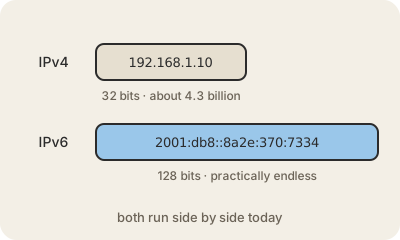
Every device on the internet needs an IP address so data can find it. The original system, IPv4, uses addresses of 32 bits, written like 192.168.1.10, which allows roughly 4.3 billion of them. That seemed plenty in the early 1980s; with phones, laptops, servers and connected gadgets everywhere, the free supply ran out in the 2010s. IPv6 is its replacement, standardized in the late 1990s.
An IPv6 address has 128 bits and is written as groups of hexadecimal digits separated by colons, like 2001:db8::8a2e:370:7334. That gives roughly 340 undecillion addresses, a number with 39 digits, enough for every device to have its own public address with plenty to spare. It also simplifies things: devices can set up their own address automatically, and there is less need for NAT, the trick that lets a whole home share a single IPv4 address.
The two versions cannot talk to each other directly, so the switch has been slow. For years most networks have run both side by side, which is called dual stack, and a large and growing share of traffic, especially on mobile networks, already travels over IPv6 without anyone noticing. You rarely need to do anything about it: your router, your phone and the sites you visit agree on which one to use by themselves.
Keep in mind
- IPv4 has roughly 4.3 billion addresses, and the free supply has run out.
- IPv6 uses 128-bit addresses, enough for practically every device imaginable.
- Its addresses look like
2001:db8::1: hexadecimal groups separated by colons. - Most networks run both versions at once while the transition continues.