4G LTE
The fourth generation of mobile networks, the one that made phones truly fast online.
4G is the fourth generation of mobile phone networks, and LTE (Long Term Evolution) is the technology almost every 4G network runs on, so the two names travel together. The first commercial LTE networks opened in Stockholm and Oslo at the end of 2009, and within a few years LTE was the standard across most of the world.
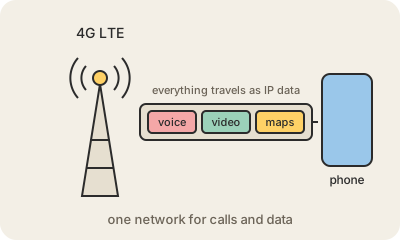
The big change from 3G was that 4G carries everything as internet data. Earlier networks were designed around phone calls, with data added on the side; LTE is built entirely on IP, the same addressing the internet uses. Even voice calls travel as data, through a system called VoLTE. That is what made video streaming, video calls, maps and ride-hailing apps feel normal on a phone.
4G is far from retired. In many countries it still carries a large share of mobile traffic and covers places 5G does not reach yet, and many 5G networks lean on the 4G network underneath. When your phone shows "LTE" or "4G", it is on this generation; when coverage is weak it may drop further, to 3G or 2G where those still exist.
Keep in mind
- 4G is the generation; LTE is the technology behind nearly all 4G networks.
- It carries everything as internet data, even voice calls (VoLTE).
- The first commercial LTE networks launched at the end of 2009.
- It still covers much of the world and supports many 5G networks.