Voice cloning
AI that learns to speak in a real person's voice from a short recording.
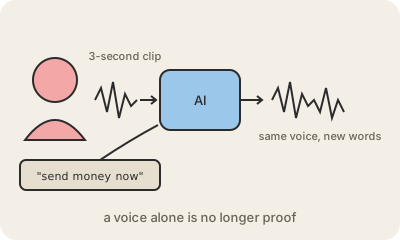
Voice cloning is getting a computer to speak in a specific person's voice. You give an AI a recording of them, and from then on it can say anything you type, with their tone, accent and way of talking. It is text-to-speech with someone's real voice instead of a generic one, and a kind of deepfake made of sound.
It used to take hours of studio recordings. Not anymore: in 2023 Microsoft researchers showed a model, VALL-E, that imitated a new voice from a 3-second sample, and commercial services like ElevenLabs let anyone clone a voice from a short clip. A few seconds give a rough copy; a few minutes of clean audio sound much closer to the real person.
There are good uses. People losing their voice to an illness can record it in advance and keep speaking with it, actors can dub themselves into other languages, and creators can fix a narration without re-recording. But it also powers scams: someone grabs a few seconds of audio from a social media video, then calls a parent with their child's voice, crying and asking for money right away. In 2024, robocalls imitating President Biden's voice told voters in New Hampshire to skip the primary, and US regulators then ruled that AI-generated voices in robocalls are illegal.
The practical defense is simple. If a call asks for money or secrets in a hurry, hang up and call the person back on a number you already have, or agree on a family code word in advance. A familiar voice alone is no longer proof of who is speaking.
Keep in mind
- A short recording is enough to make an AI speak in someone's voice.
- Useful for people losing their voice, for dubbing and for narration.
- Used in scams that fake a relative asking for urgent money.
- Defense: hang up, call back on a known number, use a family code word.