Thermal throttling
A chip slowing itself down on purpose so it does not overheat.
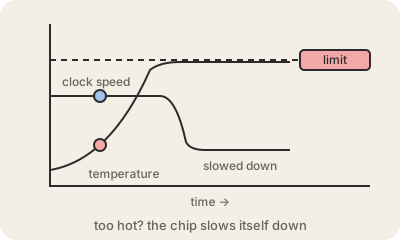
Processors turn almost all the electricity they use into heat, and the faster they run, the more heat they make. Every chip has a maximum safe temperature, often around 95 to 105 °C for laptop and desktop CPUs. Thermal throttling is what happens when a chip gets close to that limit: it automatically lowers its clock speed, and often its voltage, to produce less heat and stay safe. It is a protection, not a fault.
You notice it as a device that starts fast and then slows down. A game runs smoothly for ten minutes and then stutters; a phone exports a video quickly at first and then crawls; a thin laptop finishes a short task in seconds but takes much longer on a long one. The chip did not get worse. It is running at, say, 2.5 GHz instead of 4.5 GHz because it cannot get rid of the heat any faster.
How much a device throttles depends mostly on its cooling: a big heat sink and fans, or liquid cooling, can keep a chip at full speed, while a fanless phone or tablet has to slow down sooner. Dust in the vents, dried-out thermal paste, a hot room or a laptop sitting on a blanket all make it worse. That is why benchmarks for phones and laptops often include a long "sustained" test, not just a quick burst.
Keep in mind
- The chip lowers its own speed when it nears its temperature limit.
- It protects the hardware; it is not a defect.
- Shows up as performance that drops after a few minutes of heavy work.
- Better cooling, clean vents and fresh thermal paste reduce it.