Text-to-video
AI that turns a written description into a short video clip.
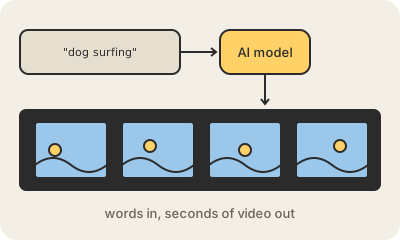
Text-to-video models generate video from a written description. You type "a golden retriever surfing at sunset, slow motion" and, a few minutes later, you get a clip that nobody ever filmed. Well-known examples include OpenAI's Sora, Google's Veo and Runway. Most can also start from an image, animating a photo or a drawing.
Under the hood they are close relatives of text-to-image models. Most are built on a diffusion model: start from random noise and clean it up step by step, guided by your words. The hard part is time. Every frame has to agree with the one before, so a person keeps the same face and a glass that breaks stays broken. Video is many images plus motion, so it takes far more computing power than a single picture, which is why clips are usually seconds long and often priced by the second.
Quality has improved fast. In 2024, OpenAI's first Sora preview showed clips that looked close to real footage, and in 2025 Google's Veo 3 added generated sound and dialogue to its videos. Weak spots remain: hands, text on signs, physics that does not quite add up, and longer scenes that drift. The same realism raises deepfake worries, so companies add visible labels and AI watermarking to what their tools produce.
Keep in mind
- It turns a text prompt, or an image, into a short generated clip.
- It is usually built on diffusion models that keep frames consistent.
- It costs far more than images, so clips are typically seconds long.
- Common flaws: odd physics, garbled text, hands and long scenes that drift.