Net neutrality
The principle that internet providers should treat all traffic the same way.
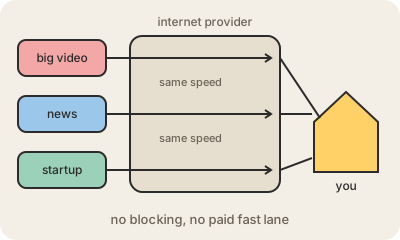
Net neutrality is the idea that your internet provider should carry all traffic equally, no matter where it comes from or what it is. It should not block a website, slow down a video service that competes with its own, or let companies pay to have their content delivered faster than everyone else's. The provider sells you a connection; what you do with it is up to you. The law professor Tim Wu popularized the term in 2003.
Supporters say neutrality is what lets a small startup reach users on the same terms as a giant, and that it protects free expression. Critics, often the providers themselves, argue that they should be free to manage their networks and sell different tiers of service, and that strict rules discourage investment. A common gray area is zero rating: plans where WhatsApp or a music app does not count against your data. It feels like a gift, but it favors some services over others.
Countries have landed in different places. Chile passed one of the first net neutrality laws in 2010, Argentina wrote the principle into its Argentina Digital law in 2014, and the European Union adopted rules in 2015. In the United States the rules have been adopted and repealed several times; the latest version was struck down by a federal court in early 2025.
Keep in mind
- Providers should not block, slow down or sell priority to specific services.
- Zero rating, free data for certain apps, is the classic gray area.
- Chile, Argentina and the European Union have neutrality rules in law.
- In the US the rules have flipped back and forth for years.