Hard disk drive
Storage that keeps data on spinning magnetic platters: slower than an SSD, but cheap.
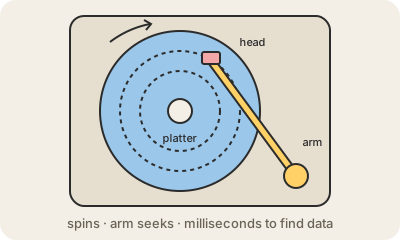
A hard disk drive (HDD) stores data magnetically on one or more round metal platters stacked inside a sealed box. The platters spin at several thousand revolutions per minute, and an arm sweeps a tiny read/write head across them, floating a hair's breadth above the surface. Writing flips the magnetic direction of microscopic spots; reading senses them. The data stays there with the power off.
Because it has moving parts, a hard disk is slow to reach data: before reading, the arm has to swing to the right track and wait for the right spot to spin under it, which takes several milliseconds. An SSD has no moving parts and answers in a fraction of a millisecond, which is why SSDs took over laptops and phones, and why a computer with a hard disk feels sluggish when booting or opening apps. Hard disks are also noisier and more fragile if dropped while running.
Their advantage is cost. Per terabyte, a hard disk is still much cheaper than an SSD, and capacities are large. So they are far from gone: data centers fill racks with them for backups, archives and the bulk of cloud storage, and home users put them in external drives and network storage boxes, anywhere lots of space matters more than speed.
Keep in mind
- Data lives on spinning magnetic platters read by a moving head.
- Several milliseconds to reach data, far slower than an SSD.
- Much cheaper per terabyte, so it remains the choice for bulk storage.
- Keeps data without power, but is sensitive to shocks while spinning.