eSIM
A SIM card built into the phone, which you load by download instead of by hand.
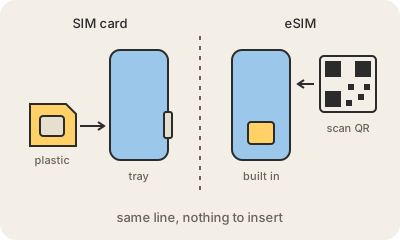
Every phone needs a SIM to join a mobile network: it holds the secret that proves to the carrier that this line is yours. For decades that was a small plastic card you pushed into a tray. An eSIM does the same job with a chip soldered inside the phone, and the line's details arrive as a downloadable profile.
To activate it, you scan a QR code the carrier gives you or follow the steps in its app. A single eSIM can store several profiles, so you can keep your local number and add a cheap data plan when you travel, without hunting for a shop at the airport. Many phones, tablets and smartwatches support it, and some recent iPhone models sold in the United States no longer have a tray at all.
Losing the physical card also removes a small risk: a thief cannot just pull it out and put it in another phone. The flip side is that moving to a new phone means transferring the profile through the phone's menus or asking the carrier, and that the same transfer process is a target for SIM swapping fraud if the carrier does not check who is asking.
Keep in mind
- An eSIM is a SIM built into the device; the line arrives as a downloadable profile.
- It is usually activated by scanning a QR code or through the carrier's app.
- One device can store several profiles, handy for travel data plans.
- Changing phones means transferring the profile instead of moving a card.