Data silo
Data locked inside one team or system, where the rest of the company can't use it.
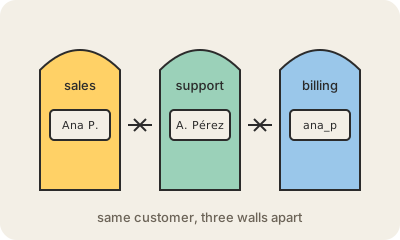
A data silo is a pile of data that only one team, tool or system can see. Sales keeps customers in its CRM, support keeps tickets in another app, billing keeps invoices in a third. Each works fine on its own, but none of them talks to the others.
Silos rarely come from bad intentions. They grow naturally: every team buys the tool that fits its job, every acquisition brings its own systems, every spreadsheet starts as a quick fix. Years later, nobody can answer a simple question like "which customers who complained last month also stopped paying?" without exporting files and matching them by hand.
The costs are real: the same customer exists five times with five different addresses, reports disagree, and work gets done twice. The usual fixes are to bring the data together in one place, such as a data warehouse or data lake, connect systems through APIs, and agree on shared definitions through data governance. The hard part is usually people and habits, not technology.
Keep in mind
- Data that only one team or system can see and use.
- Grows naturally from separate tools, teams and acquisitions.
- Leads to duplicated records, conflicting reports and wasted work.
- Fixed by centralizing data and agreeing on shared definitions.