Amazon Athena
Run SQL directly on files sitting in S3, with no database to set up.
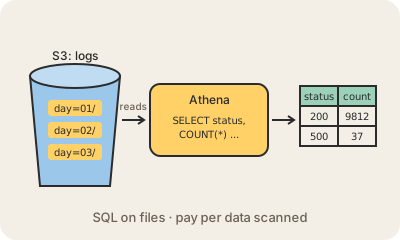
Amazon Athena is a query service: you point it at files stored in Amazon S3 (CSV, JSON, Parquet, logs), describe their columns once, and run standard SQL against them. There is no server to start and no data to load: Athena reads the files when you run the query, and you pay per amount of data scanned (roughly 5 dollars per terabyte).
It exists because a lot of valuable data lives as files, not inside a database: application logs, exports from other systems, clickstreams, sensor readings. Loading all of that into a data warehouse is slow and costly; with Athena you query it where it is. It is the query engine of the data lake pattern: S3 as the storage, the AWS Glue Data Catalog as the list of tables and columns, Athena as the SQL layer.
Example: a company keeps a year of web server logs in S3, in one folder per day. An analyst runs SELECT status, COUNT(*) FROM logs WHERE day = '2026-10-01' GROUP BY status and gets the answer in seconds, scanning only that day's folder. Converting the logs to Parquet, a compressed column-oriented format, makes the same query scan far less data and cost far less.
Athena is built on Trino (formerly Presto) and can also run Apache Spark. It shines for ad hoc analysis and scheduled reports; for a team hitting the same tables all day and expecting sub-second answers, a warehouse like Amazon Redshift is the better fit.
Keep in mind
- Serverless SQL over files in S3: no cluster to run, no loading step.
- Billed per data scanned, so columnar formats like Parquet and folder partitions cut costs a lot.
- Table definitions live in the Glue Data Catalog and are shared with other AWS tools.
- Great for ad hoc analysis and logs; a warehouse suits heavy, constant workloads.