Private cloud
Cloud-style computing reserved for a single organization.
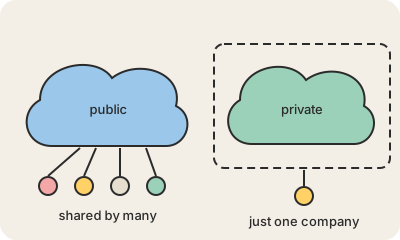
A private cloud gives one organization the conveniences of the cloud, such as creating servers and storage on demand from a portal or an API, but on infrastructure that only that organization uses. It is the opposite of a public cloud like AWS, Azure or Google Cloud, where the same giant data centers are shared by millions of customers, each walled off in software.
It usually lives in the company's own data center, built with software like VMware or OpenStack, but it can also be hardware a provider hosts and runs for just one customer. What makes it a cloud rather than a plain server room is self-service and automation: a team asks for a virtual machine and gets it in minutes, without filing a ticket and waiting weeks.
Banks, hospitals and governments choose private clouds when rules or risk make them want full control over where data lives and who touches the hardware. The price is that the company buys the machines up front, has to plan capacity itself and employs the people who keep it running. Many end up mixing both, which is called hybrid cloud.
Keep in mind
- Cloud-style self-service on infrastructure used by one organization only.
- Can run in the company's own data center or be hosted by a provider.
- More control over data and hardware; more cost and work up front.
- Combining it with a public cloud is called hybrid cloud.