Cloud outage
When a cloud provider fails and many apps and websites go down with it.
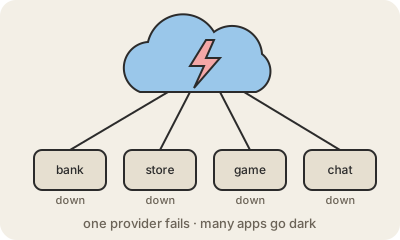
A cloud outage is when part of a cloud provider stops working: servers, storage, the network or one of its key internal services. Because so many companies rent their computers from the same few providers, a single failure can knock out banks, stores, games and messaging apps at the same time, even though none of them did anything wrong.
Outages rarely start with a whole data center burning down. More often a small mistake spreads. In February 2017, a mistyped command during routine work took down Amazon S3 in AWS's Northern Virginia region (US-EAST-1) for hours, and many websites broke with it. In October 2025, a DNS problem with DynamoDB in that same region set off failures across many AWS services, and popular apps were down for many hours.
Providers run public status pages and, after big events, publish a written summary of what went wrong. For companies, the lesson is to design for failure: spread copies across availability zones or even regions, know what depends on what, and have a plan for running in a reduced mode. For everyone else, it is a reminder that the cloud is real buildings full of machines run by people.
Keep in mind
- One provider failure can take down many unrelated apps at once.
- Big outages often start small, with a change or a configuration mistake.
- Providers publish status pages and summaries after major events.
- Spreading across zones and regions limits the damage.