Cloud-native
Software designed from the start to take advantage of the cloud, not just moved into it.
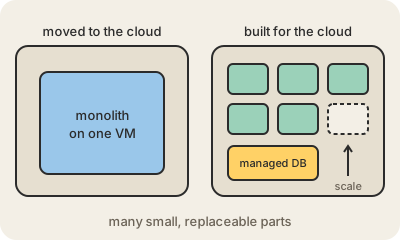
Cloud-native describes software built to make the most of how the cloud works: resources that appear and disappear on demand, machines that can fail at any time, and services you rent instead of run. The opposite is an application designed for one big server in an office, copied as-is onto a virtual machine in the cloud. That runs, but it gets few of the benefits.
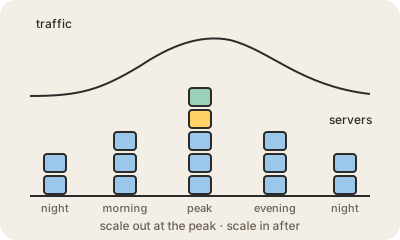
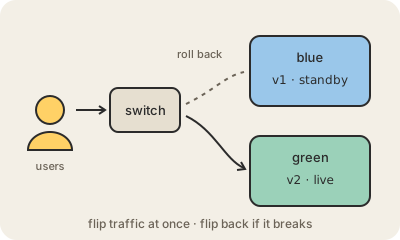
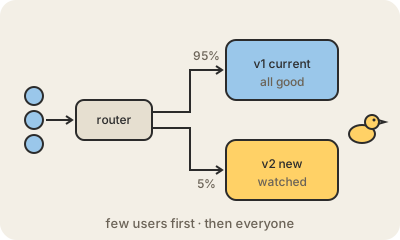
In practice, cloud-native systems tend to share a toolkit: the app is split into smaller services (often microservices) packaged in containers, run by an orchestrator like Kubernetes or on serverless platforms, with infrastructure described as code and released through automated CI/CD pipelines. Servers are treated as disposable: you do not repair a broken one, you replace it. Data lives in managed services, and each part can scale on its own when traffic grows.
The term is closely tied to the Cloud Native Computing Foundation (CNCF), founded in 2015 under the Linux Foundation, which hosts Kubernetes and many related open-source projects. Its definition stresses systems that are resilient, manageable and observable, so teams can change them often and with confidence. Cloud-native is not free: more moving parts mean more complexity to operate and monitor, and for a small, stable app a simple server can be the better choice.
Keep in mind
- Built for the cloud, not just moved to it.
- Typical pieces: containers, microservices, Kubernetes or serverless, IaC, CI/CD.
- Servers are disposable; failures are expected and handled automatically.
- More flexibility comes with more complexity to run.