Zoom
A video meeting app, and the company behind it, that became a verb during the pandemic.
Zoom is a video calling service made by an American company of the same name, founded in 2011 by Eric Yuan, an engineer who had worked on Cisco's WebEx video conferencing product. Its pitch was simple: meetings that just work, joined by clicking a link, with good quality even on a mediocre connection. It was popular with businesses, but the COVID-19 pandemic in 2020 made it part of everyday life: school classes, doctor's appointments, birthdays and family dinners moved to Zoom.
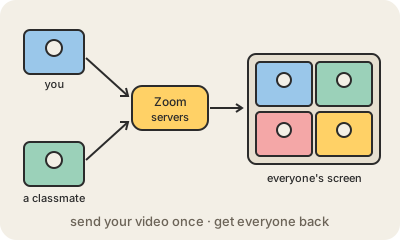
Behind a call, each participant's app compresses its camera and microphone into a stream and sends it to Zoom's servers in data centers around the world. Those servers forward the right streams to everyone else, often at lower quality for the small tiles and higher for whoever is speaking. That is how a laptop can show a grid of dozens of faces without having to receive every video at full resolution.
The sudden growth also exposed problems. Uninvited people joined unprotected meetings to disrupt them, a prank that got its own name, Zoombombing, and the company was criticized over its security and privacy claims. It responded with waiting rooms, passcodes on by default and end-to-end encryption as an option. Today it sells a family of products around meetings, such as phone systems, chat, webinars and AI assistants that summarize calls, and competes with Microsoft Teams and Google Meet.
Keep in mind
- Founded in 2011 by Eric Yuan, a former Cisco WebEx engineer.
- Exploded during the 2020 pandemic, when classes and work went online.
- Its servers forward each person's video stream to the other participants.
- Zoombombing pushed it to add waiting rooms, passcodes and optional end-to-end encryption.