Synthetic data
Data made up by a program to look like the real thing, used to train or test.
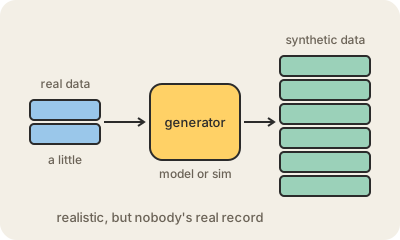
Synthetic data is information generated artificially instead of collected from the world. A program, a simulation or an AI model produces records, images or text that have the same shape and patterns as real data, but describe no real person or event.
It solves three common problems. Privacy: a hospital can share synthetic patient records that keep the statistics of the real ones without exposing anyone. Scarcity: a self-driving car rarely sees a child running behind a ball at dusk, but a simulator can produce thousands of such scenes. Cost: writing ten thousand good question-and-answer pairs by hand is slow, while a large model can draft them in an afternoon, which is now a normal part of how LLMs are trained and fine-tuned.
The catch is that synthetic data is only as good as the thing that made it. It copies the biases and blind spots of its source, and it can miss the weird cases that make real data hard. Researchers have also shown that models trained over and over on the output of other models slowly lose variety and quality, an effect called model collapse. In practice, the best results mix synthetic data with real data and check both carefully.
Keep in mind
- Artificial data that mimics the patterns of real data.
- Helps with privacy, rare cases and the cost of collecting examples.
- Inherits the biases and gaps of whatever generated it.
- Works best mixed with real data, not replacing it.