Sovereign cloud
A cloud built so data and its control stay under one country's or region's laws.
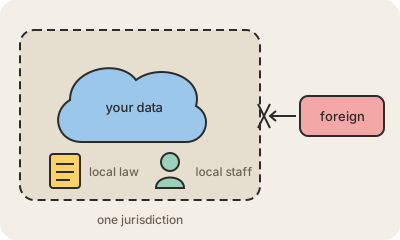
A sovereign cloud is a cloud service designed so that the data, the operations and the legal control over it all stay inside a given jurisdiction, usually a country or the European Union. It goes further than keeping data in a local data center: the people who run it, the company that legally owns it and the keys that encrypt the data are meant to be local too.
The worry behind it is legal, not technical. Most large clouds are run by U.S. companies, and laws like the U.S. CLOUD Act can oblige those companies to hand over data they control, even when it is stored abroad. Governments, hospitals, defense contractors and banks, especially in Europe, want guarantees that a foreign authority cannot reach their data or switch off their systems. This wider goal is often called digital sovereignty.
There are several ways to get there: national providers, partnerships where a local company operates a big provider's technology, or big providers building separate, locally run clouds. AWS, for example, launched the AWS European Sovereign Cloud, physically and logically separate from its other Regions, with its first Region in Brandenburg, Germany, and operated by EU-based staff. The trade-offs are usually fewer services, later access to new features and higher prices.
Keep in mind
- Data, operations and legal control stay inside one jurisdiction.
- Goes beyond data location: who operates it and who owns it matter too.
- Driven by concerns over foreign laws reaching data, like the U.S. CLOUD Act.
- Often means fewer services and higher cost than the global cloud.